Saturday, March 13, 2021

Thoughts While Changing a Tire

 As I was struggling to change a tire this morning the thought struck me that it would be almost impossible for an 18-year old girl to change a tire by herself in the dark which should be the standard that auto companies strive for when designing tire changing stuff.

When my now 20 year-old daughter headed off to college a couple of years ago, I made sure she knew how to change a tire and jumpstart a battery. I also made sure she understood that the world is cruel place and that bad things can happen to girls. I wanted her to be as independent as possible so she can mitigate such risks as much as possible.

Anyway, back to the tire. I am a farmer who is familiar with changing tires an so forth and it was a pain in the ass to change this tire.

I have a new (to me) Dodge Ram pickup and this was the first time I had to change a tire on it.


The first problem involved finding the jack and tire wrench. I looked in all the usual places and was unable to find it, so I looked in the book and then found it.

The second problem was getting the tire repair package free from its holding mechanism. This required loosening a bolt that held the mechanism in place. I could not get it free by bare hands so the first of my trips to our farm shop which is about 2 miles away from my house was to get a plier.

Even using the plier, I was barely able to free the bolt. There is simply no way that an 18-year old girl could have gotten it free by herself in the dark.

Then I tried the tire wrench on the lug nuts, and again, they were impossible to free bare-handed. Hence the second trip to the farm shop to get a length of pipe to put on the tire wrench to make turning the lug nuts easier. Obviously, an 18-year old girl changing the tire by herself in the dark probably would not have access to a length of pipe.

However, there is a work-around for this step, if she was able to step on the tire wrench and apply her weight to it, she might be able to get the lug nuts loose.

Then after the lug nuts were removed. I was not able to free the tire from the vehicle. This required a 3rd trip to the farm shop to get a sledge hammer to free the tire from the vehicle. A typical 18-year-old girl changing the tire by herself in the dark probably would not have access to a sledge hammer.

You might note that the above steps leave out any jack-related problems. I did not use the jack from the vehicle and used a farm jack instead. So besides all of the above, there are possible jack-related  difficulties that might multiply the problems for a typical 18-year old girl changing the tire by herself in the dark.

You might also note that I also leave out any potential issues regarding removing the spare tire from underneath the pickup and putting it on as I skipped that step and left the vehicle on the jack while I took the tire to be repaired.

A couple of months ago, my daughter called me from college and she was so proud of herself. Her roommate had a flat tire and was going to call AAA but they decided to change the tire themselves and they did it. Needless to say, I was very proud of her as well. AAA is not always going to be available.

Tuesday, December 15, 2020

Sergeant Hutton and Shakespeare

 Continuing with my riff on Patton's "Through a Glass Darkly" which is adapted for use here as smelling the smoke of a thousand campfires; I am pondering a story about Shakespeare from George MacDonald Fraser's highly acclaimed memoir of his World War 2 service in the Burma campaign called Quartered Safe Out Here.

One episode of the book has Fraser receiving 2 books from home; one of which was Shakespeare's Henry V and the other was a more comedic book called 3 Men in a Boat . He figured the "Boat" book would be passed around his section, but he expected few takers for the Shakespeare.

To Fraser's surprise, his sergeant, Sergeant Hutton commandeered the Shakespeare and kept it for several days. Hutton returned the book and returned it with the question: "Was Shekspeer ivver in th' army?

Fraser responded that most scholars did not think so, but that there were just enough gaps in his life that he might have served in the Low Countries or even Italy.

As the conversation developed, Sergeant Hutton was adamant that Shakespeare had to have been in the army. In his view, he knew too much about it and it wasn't the kind of stuff you could just learn by talking to military men in the pubs.

Keep in mind, that this was in Burma in 1945 and Sergeant Hutton's service went back to 1914, or even earlier. Hutton knew war, if anybody did. He would have recognized the difference between war and pub talk..

Fraser walked away from the conversation wondering to his dying days if Shakespeare really was in the army.

One of my main thoughts on reading this episode, is that it is a shame that Quartered Safe Out Here is unlikely to find itself into the hands of many modern Shakespeare scholars. Sergeant Hutton's opinion on the Bard of Avon would provide a take on Shakespeare that is probably missing in the modern academy.

Another thought is that Sergeant Hutton was closer in spirit to the Groundlings who attended Shakespeare's plays at the Globe Theater than any modern academician or theater-goer can possibly be.

And then, since my mind turns in that direction, the thought that maybe Shakespeare was in the Army; just not as Shakespeare, but before he was Shakespeare. 

Maybe he really was there and smelled the smoke of a thousand campfires the night before the battle on the muddy field of Agincourt with Henry V and them.


Wednesday, April 15, 2020

Burnham #3 ="Searching for Lost Cities"

By David Wrolson

Jim at Frontier Partisans has post on the adventure side of Burnhams's life.

https://frontierpartisans.com/18455/burnham-haggard-on-the-imperial-frontier/

>>>"The conduit between myth and legend and real life adventure was wide open and flowing in both directions in late 19th century southern Africa. Burnham would explore the ruins of Great Zimbabwe, which at that time were believed by white explorers to be evidence of a lost white tribe’s sojourn in the African interior. “Lost cities” would become a trope of pulp fiction through the first half of the 20th Century."<<<<

Not many non-archaeologists can say this, but I have searched for lost cities. I majored in


Tuesday, April 14, 2020

Burnham #2-"The Smell of the Big Strike"

By David Wrolson

I discussed the possibility that Frederick Russell Burnham's might be one of the campfires I smell from the past in my previous post here in "The Smell of a Toddler's Urine." I found another tie in the lure of the big strike.

It is interesting that Burnham who prospected around the world found his lasting wealth later in life at the Dominguez Oil Field. This oil field was located on land that had long been familiar to him and which had been overlooked by other oil companies.

Readers will note how close it is too the heart of the Los Angeles basin.


From the Wikipedia article on the Dominguez Oil Field.

>>>"The spot where Burnham found oil was land where "as a small boy (in the 1870s) he used to graze cattle, and shoot game which he sold to the neighboring mining districts to support his widowed mother and infant brother."[5]"<<<<<

At the end of the day, one has to think of Burnham primarily as a prospector; an oilman if you will, among many other things.

Oddly enough, I too am an oilman; by inclination if not by profession. I make my living in agriculture but for reasons to lengthy to cover here, I am not able to call myself a farmer.

Neither of my ventures in college involved geology or anything related to oil, except for the second time in  my 30's when I majored in Geography and especially enjoyed a high level class on Geomorphology or landforms

Prior to first learning of Burnham in the fall.of 2009, I became fascinated with the Bakken oil field activity in North Dakota and wanted to learn everything about it. From the Bakken, I branched out into learning as much as I could about oil and oil geology and so forth,

I began to think of myself as an oilman and not as a farmer. Was this Burnham, the prospector and oilman, coming through?

Oddly enough, I have oil seeps on some of my land in Minnesota far from any known oil fields. This land is a 220-acre parcel of mostly pasture with 2 known oil seeps that are about 3/4 mile apart.

 This property is a rugged piece of land that is out of character with most of the land in the area. I call it a little bit of "Wyoming"here.

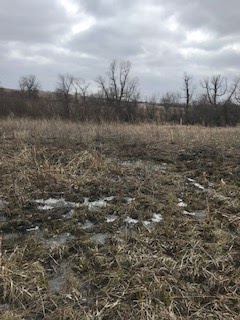
These oil seeps look like a puddle of water with waste oil spilled on top. The picture below shows the western oil seep. It is currently frozen so no oil is visible.

 The following pictures are of the landscape taken from the west side of the property and then from the east side.


There is oil there in quantity. I can smell it. With modern horizontal drilling and imaging techniques we could get to it. It is there. I feel the prospector and the wildcat oilman (the Burnham?) in me getting more excited by the day.

But, the farmer that I am now killed the possibility of getting to it. For financial reasons, I was forced to sell a conservation easement on the property to remodel some hog barns that have been a millstone around my neck for 25 years. So going after the oil is not legally possible.

My wife didn't want me to sell this easement and she was right. However, she understands that we really had no choice.

But the oilman and the prospector in me is confused and pissed. There is oil there. We own the land. Why can't we go after it?

All I can do is apologize to my true-self and say "I know. It really sucks to feel the lure of the big strike and we can't even go after it. Worse yet, I have to look at it every day."


Monday, April 13, 2020

Burnham #1-The Smell of a Toddler's Urine

By David Wrolson

Continuing the theme that while Patton saw his past lives "Through a Glass Darkly" some may sense these lives through the sense of smell.

This post is about the smell of a toddler's urine and the idea that this urine might belong to the famous scout Frederick Russell Burnham.


I first learned of Burnham when I opened his autobiography "Scouting on Two Continents" at age 43 in the fall of 2009. I had never heard of him before, but within a few pages, I was struck with the overwhelming sense that I had been him in a previous life. I have never had this sensation in any other book I read before or since.

The sensation lasted a few minutes and then went away, but I always wonder a little bit if it meant anything.

A toddler's urine is the smell that I associate with the Burnham campfire in my journey of smelling a thousand campfires.

There is one episode in his adventurous life that makes a lot more sense if he had lived lives of danger before and smelled a lot of campfires along the way.

As a young child, his family lived in Minnesota during the 1862 Dakota Sioux Uprising.


One evening, his mother saw a war party of Sioux approaching and realized she could not get away with him. She hid him in a shock of green corn as that would be too green to burn and told him to stay there and remain silent.

The Sioux burned her cabin, but Burnham remained safe and quiet in the corn all night. His mother returned the next morning with armed neighbors and found him safe. Sometimes, I can smell toddler's urine when I think of Burnham and his (my?) night in the corn shock.

How does a toddler know that danger is around him and he has to remain quiet. Given his later life, it is no surprise, but as a 15-month old he performed a feat of survival that many adults could not, simply by remaining patient.

I think prior to being Burnham; he was Jumping Bull, the father of Sitting Bull. Therefore, the danger of enemy indians was ingrained within him.

In addition to the sense I had when I opened "Scouting." I share a love of Rhodesia with him. Burnham was instrumental in the early days of Rhodesia. While Rhodesia is gone now and it is the basket case known as Zimbabwe, I was there on a hunting trip in 2013 and I felt at home there, as if I had been there before.

Sunday, April 12, 2020

The Smell of Bathsheba's Skin

By David Wrolson

Any readers may remember my riff in the first post on this blog that while Patton saw his past lives "Through a Glass Darkly," some may find scents evocative of other times and places.

One day, while going about my work alone on the farm, I smelled a woman's perfumed skin. She was not of this time or place. I think her name was Bathsheba. No, I know her name was Bathsheba.

What do I know about a woman named Bathsheba and why would I smell her skin? King David is known for his great sin with her and his betrayal of her husband, Uriah the Hittite. Uriah was one of King David's great soldiers. One of his mighty men, if you will. The first child of King David and Bathsheba, the child of his sin, died. However, a later child grew up to become King Solomon.

A short refresher of the biblical story is that King David saw Bathsheba cleansing herself according to Hebrew tradition and became entranced by her beauty and either seduced or raped her.


Bathsheba became pregnant and King David sent for Uriah, her husband, who was away at the wars to sleep with her and cover his indiscretion. Uriah refused to sleep with her as his comrades at the wars were still away from their wives.

King David then ordered his general to place Uriah in a place of great danger so he would be killed in battle.
But none of that answers the question as to why I would smell Bathsheba's skin. Does that mean I was King David? I don't think so. I think I was Uriah and I smelled the skin of my young wife.

I remember as a child asking my mother why she named me David in light of his horrible crime. What kind of kid asks that? Do I carry the wounds of King David's betrayal deep in my soul?

People forget that Uriah and Bathsheba were a married couple. We made love. When we married, she made herself ready for me and she perfumed her skin and the older women gave her advice.

I do not think of Bathsheba as the mother of King Solomon or a wife of King David. I think of her as a young bride on our wedding day preparing herself for her husband.

Friday, May 10, 2019

Dunkirk: We Can't Even Name True Fascism

By David Wrolson

Dunkirk: We Can’t Even Name True Fascism
I mentioned in a previous essay that I hate the movie Dunkirk to the core of my soul and with the heat of a thousand suns. Dunkirk almost feels demonic to me. The movie is perfectly aligned to fit modern sensibilities.

Less than a minute into the movie; the following word crawl appeared on the screen.
“The Enemy have driven the British and French armies to the sea. Trapped at Dunkirk they await their fate.”

“The Enemy”
My hatred for the movie started from that point. I could instantly see where the filmmakers were going. The other team was going to be a nameless, faceless “Enemy” and not Nazis. For all the current talk of standing against Fascism and so forth, we can’t even name true Fascism when we were battling for our lives against it.

The movie starts with a squad of soldiers in a deserted town that come under machine gun fire and are almost completely wiped out except for the main character in the movie.

We are then dropped with no context on a beach full of confused, frightened men. However, the real Dunkirk men had context.

They had just fought a bitter, fighting retreat and they had fought as well as they could under the circumstances. They, and countless others who didn’t make it to Dunkirk, had cost the Germans 156,000 casualties. Among those casualties, they had killed 27,000 Germans. The movie takes that honor away from them.

Throughout the movie, the British soldiers call the other team “The Enemy.” In real life, they called him “Hun, Jerry or Kraut.” In the Far East, they called him “Jap” or “Nip.” The movie dehumanizes the British soldier by having him call the enemy, “The Enemy.” To me, it is one of the ugliest features of the movie.

I think calling the other team “The Enemy” also does a disservice to the German soldier as well. He was caught up in service to a monstrous regime, but he was a flesh and blood man and it is important to remember that.


Ad-Hoc Units
We see the main character hiding on the pier to try sneak on a ship. He displays no courage or selflessness. His actions in the movie mirror what we in modern times expect that the typical behavior of a soldier is because it is what we see ourselves doing.

He is separated from his unit and appears to be alone. However, throughout history, ad-hoc units of soldiers separated from their units during confusing retreats or defeats or even advances fought well and they earned their place in Valhalla.

War Is Hell
Every scene of the movie seems geared to one objective. That objective is to show that “War is Hell.” That seemed to be all the filmmaker was after. In that aspect, once again, the movie is perfectly aligned with modern sensibilities. We think there is nothing worse than war.

Au contraire, there are many things worse than war. The Soviet Gulags were worse than war. The loss of the buffalo to the Cheyenne was worse than war. I fear that the outcome of the rapid move to artificial intelligence will be worse than war.

“The Enemy Could Be Right Over There”
Midway through the movie, our “hero” (loosely speaking) is with a group of soldiers who find a beached boat that might be usable at high tide. As the soldiers enter the boat they glance toward some sand dunes and one says “The enemy could be right over there.”

However, they just hide themselves in the bottom of the boat and post no sentries. Knowing what the movie is: it would be a bridge too far to expect them to scout the dunes, but they could have at least posted a sentry. This scene is the burning focus of my hatred for the movie.

So who are these Germans of whom you speak?
The only reference to Germans in the movie that I am aware of are when the Dutch boat captain comes back to his boat and the soldiers grab him and ask him if he is German and why he left the boat. He says “In case the Germans come back.”
Wow, completely out of the blue we hear of Germans. Given the lack of historical literacy among our youth I am not certain that very many know that “The Enemy” at Dunkirk was the Germans.

A Part of Something Larger Than Yourself
The only ones in the movie who are shown as a part of something larger than themselves are the crew of the small boat who are on their way to Dunkirk to rescue soldiers.

However, even this storyline is irretrievably marred by the inclusion of the shell-shocked soldier picked up in the channel who fights against going back to Dunkirk to pick up his comrades.

Once again, courage and self-sacrifice find no place in this movie. The film makers can’t begin to grasp that wounded soldiers throughout time have fought to get back to their comrades.

The shell-shocked soldier storyline is just another way of stripping honor from soldiers. It fits with our modern sensibilities of every one as a victim and that is how we see ourselves acting in that position.

One of the things I hate the most about the times we find ourselves living in is that we have stripped the honor from soldiers and, instead, we view them as victims.


Wednesday, May 8, 2019

They Paved Paradise and Put Up a Waterpark

By David Wrolson

My wife just saw an ad that Royal Caribbean Cruise Lines just finished a 250 million dollar makeover of their small private Bahamian island named Coco Cay.  Their new name for the place is "A Perfect Day at CocoCay."


The following is taken from a CNN story on the transformation

>>>"Thanks to a $250 million transformation, Royal Caribbean's once-sleepy private island retreat in the Bahamas is offering eye-opening travel amenities to its cruise passengers.
The island, Perfect Day at CocoCay, offers everything from a record-setting water slide and a massive wave pool to five new complimentary dining venues and quiet sandy beaches.
"We are so proud to bring our 50-year legacy of innovation ashore to transform an incredible island that now completely revolutionizes private destinations in the vacation industry," said Michael Bayley, Royal Caribbean International's president and CEO, in a statement".<<<<
I grow wistful when I think of my perfect day at CocoCay almost 20 years ago. I previously described this in another blog, but I bring it forward here. There is obviously no room on the new plasticized CocoCay for someone like me to visit with a Bahamian cop and have him make me a fresh conch salad. I thanks the Lord I wasn't born no later than I was.
I had always feared a cruise. I get restless easily and I figured I would find a cruise confining. It was not as bad as I thought. 
Anyway, the ship stopped in Nassau. Having read about the Bahamas, I wanted to eat their national dish, conch, a mussel-like thing that they fix in many forms.

We stopped at a little restaurant  and had conch fritters. This is when Encyclopedia Boy stepped into action. I started visiting with the owner about the Bahamas and where he was from. I will remember to my dying day that he was originally from Andros Island, but I can't remember to take out hamburger for supper.

My favorite memory of the cruise happened on the private island where the ship docked for a day of island activities. Lori was on the beach most of the day and I went wandering off. I had a long visit with a Bahamian police officer, mainly about hunting and fishing. 

I told him that I wanted to eat conch while in the Bahamas and that there were some in the water on the beach where Lori was sitting. He had me catch one and he walked me back to an area near the worker's quarters.

He told me to stay there and he would be back. It took about 20 minutes and I figured he was playing a joke on the American tourist. But, eventually he came back with another guy and they cut up my conch and made a salad. That was really neat. I am proud of myself that within the structured confines of a cruise I was able to have an experience that none of the hundreds of thousands of tourists who have been on the island have likely had.

My point is, that I really like to feel the geography of a place when I am there and I am hoping for that in Africa.

We will probably go back to Mexico or another tropical beach site, but I think a repeat visit to an all-inclusive resort would have the feel of "Been there, done that-let's do something else." In this case, something else is a hunt in Africa.

Tuesday, April 16, 2019

How Did She Know?

By David Wrolson

What happens to your soul when you are born to be a soldier, but you don't answer the calling?

Writing this at age 52, one of the great mysteries of my life is why I never became a soldier. It was all I ever really wanted to do, really ever. And part of my life seems wrong because of it. I was not true to myself during those crucial enlistment years.

One of my few memories of kindergarten is looking at a picture in a book of President Lincoln flanked by 2 soldiers. A female classmate that was looking at the book said "David (that's me)wants to be a soldier." Had I made it that obvious to my peers at that young age?

Thursday, February 21, 2019

Bad News From Burkina Faso

One of the themes I am going for in this blog is of things that I find transcendent. The bible talks of a New Heaven and a New Earth. I think, sometimes,  if we are very lucky we catch glimpses of the New Earth. The wild plums that I mentioned in a previous post were transcendent and a glimpse of the New Earth, or as termed it there, the New Narnia.

Over the last few years, I caught a glimpse of the New Earth from the most unlikely quarter. Burkina Faso!!! Burkina Faso is a landlocked nation in the West African Sahel and Savanna that few outsiders could find on a map and that fewer still have ever been to. It is a nation of grinding poverty in a poor quarter of the poorest continent.

I have a deep interest in African wildlife conservation and I had long since written off this area as an area where the wildlife were simply gone. It is too poor, too heavily populated and too conflict ridden.

However, I started seeing a few hunting reports from southeastern Burkina Faso. Along with adjoining lands in Benin and Niger, it was a region described as "the largest protected area still rich in wildlife in West Africa."

Aldo Leopold once said>>>

“One of the penalties of an ecological education is that one lives alone in a world of wounds.<<<

Right now, I am nursing a wound over a place that I have never been and that most could not place on a map. 

Friday, February 8, 2019

"Despite"-The Ugliest Word I have Ever Read

By David Wrolson

As the father of a daughter, I am completely flabbergasted by a sentence in "Little House, Long Shadow" by Anita Clair Fellman. Fellman is a Women's Studies professor whose book is an examination of the supposed "dark shadow" cast by the Little House series of books. It will surprise no one to know that she largely views the "Little House" books as impacting society in a negative way.


One sentence (one word really) from this book is burned into my mind and really tells you all you need to know about the mindset of Women's Studies professors.

"And despite the strong bond between Laura and Pa described in the books, nothing suggests that there was an incestuous relationship between the two of them,"

"Despite", really!!!! WTF???? So Fellman's default position of fathers and daughters with a strong bond is to automatically assume an incestuous relationship. No wonder our young women come out of the Women's Studies courses so poisoned.

I have a strong bond with my now 17-YO daughter and in my previous post I described one of "Our" things which is picking wild plums. We have other "Our" things. Of the 3 kids, she is my big-game hunter and, maybe even, someday, my farmer. I dream of taking her to Africa.

But, I guess Ms. Fellman would assume that our relationship is incestuous because, in her world, fathers and daughters with a strong bond are automatically that way, unless nothing suggests so.

"Despite"-Words mean things and Ms. Fellman just threw that word out there without any thought as to what it really means. It was just another word to her, but it clarifies what poison comes out of Women's Studies departments. "Despite."

I shouldn't wish this on anyone, but part of me hopes that Ms. Fellman burns in Hell forever, for that one word, haunted by visions of Laura and Pa just being Laura and Pa. I also wouldn't mind if some visions of me and my daughter picking wild plums were included.

Despite


Thursday, February 7, 2019

I Have Seen the New Narnia

By David Wrolson

The Chronicles of Narnia series ends with the creation of the New Narnia which is like Narnia, but better. This is an obvious metaphor based on the New Heaven and the New Earth at the end of the bible.

I like to use the phrase "I have seen the New Narnia" for something transcendent and that raises the soul.

I have seen the New Narnia but we had to earn it to appreciate it.

My daughter and I like to pick wild plums and my wife makes jelly from them. After picking wild plums for several years, we knew what wild plums looked like. They are a certain size and level of juiciness and that is just what wild plums are.

Then we found the New Narnia. A few trees in an odd corner of a woods. The wild plums there are twice the size of regular plums and the juiciness is unbelievable.

I am glad that we did not find these plums first as we would not have appreciated them.

With those plums, I got a sense of the "New Earth." They are that transcendent and nothing can take that sense away from me.

The Ragged Edges of the Land

By David Wrolson

I love the ragged edges of the land

The odd corner, the brush pile

The rocky shore calls to me

Farmers hate odd-shaped fields

I am a farmer, but I love odd-shaped fields

They are just more interesting

My heart breaks every day

The ragged edges of the land are going away

Wednesday, February 6, 2019

Smelling the Smoke of a Thousand Campfires

By David Wrolson:

General Patton described his vision of past lives in a poem titled "Through a Glass Darkly."

So as through a glass, and darkly
The age long strife I see
Where I fought in many guises,
Many names, but always me.


I sense these lives differently.

If I close my eyes just right, I can smell the smoke of a thousand campfires. I think they are Roman, but I am not sure. I can sense the dark woods of Teutoburger Wald closing in. Teutoburger Wald where 3 Roman legions were destroyed by Germanic Tribes.

I can smell the horseshit and the sweat and fear of men at the Horns of Hattin. We were so thirsty there.

The earth thrums for me in Colorado. I was Cheyenne there at the height of our years of power.  I hate the Comanche. Later we fought the white men together, but in my time we were enemies. They killed me, I think. I was at the height of manhood when I went away. We could not know how fast the buffalo would go.

Now I go west across the plains, always looking for something. I am looking for the buffalo and I am confused that they are gone.

I hate the movie Dunkirk to the core of my soul and with the heat of a thousand suns. You can't hate that movie as much as I do just from one human life. I hate it on behalf of those who died with me and those who killed us.

I am a farmer now, and the earth is in me. I have been a farmer before. I can feel it, I know it.

Now, I know nothing of horses, but I yearn for the day of the horse. Something big is missing in this time. It took me a long time to figure it out, but the horses are gone and things just don't seem right without them.

I like to see what is over the hill. I have scouted new paths and visited new lands.

I have hunted Zimbabwe in this life. That patch of land is very important to me, but it is Rhodesia that I love. I have been there before with Burnham and Selous and Rhodes. I love that land as I love no other. But it is gone now. I lost someone very close to me in Rhodesia. I know it. I feel it.

Was I Burnham? Did I lose my daughter there? Was the jolt of recognition I felt when I opened his biography "Scouting on Two Continents" real or merely imagined? He was a scout, but he was also oil and mining and those are in me as well.


Thoughts While Changing a Tire

 As I was struggling to change a tire this morning the thought struck me that it would be almost impossible for an 18-year old girl to chang...